

✕
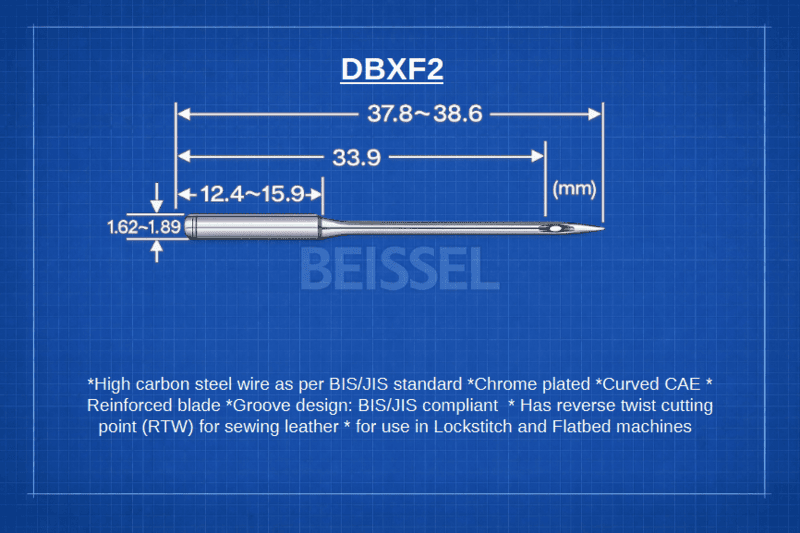
DBXF2
The 134 series sewing machine needles are used in heavy-duty industrial lockstitch machines. These systems are ideal for sewing leather, upholstery, footwear, automotive interiors, and thick fabrics, offering excellent stitch strength and penetration.
₹5,240.00
₹5,240.00
₹5,240.00
₹5,240.00
₹5,240.00
₹5,240.00
₹5,240.00
Log in for dealer pricing
Non-returnable
Out of stock Out of stock Out of stock Out of stock Out of stock Out of stock
size
Select size
point
Select point
No.of Needles Per Pack / Box
Select No.of Needles Per Pack / Box
Customize
[tag] QUALITY ASSURANCE || [title] Always Choose BIS, JIS or DIN Certified Needles || [text] These international standards define what a good needle must be. But certification alone is not enough — look for ISO certification too. ISO confirms the manufacturer has consistent systems in place to meet those standards every single time. That's your guarantee of a needle you can trust. || [tag] NEEDLE CONSTRUCTION || [title] Insist on a Milled Groove — Not a Pressed One || [text] The groove in a needle protects your thread during high-speed sewing. Milled grooves meet the precise depth and width required by standards. Beware of needles marketed as "Loop Control" or similar — these often use pressed grooves that fall short, leaving your thread exposed to fraying and breakage. || [tag] MACHINE SAFETY || [title] Cheap Needles Cost You Far More Than You Save || [text] Standards specify the wire quality a needle must be made from. Only the right wire gives you a sharp, long-lasting tip that won't bend or break. Cheap needles use inferior wire — and when they fail, they damage your throat plate, shuttle hook and other machine parts. The cost of repairs will far outweigh any saving on the needle. || [tag] BEST PRACTICE || [title] Change Your Needle Every Alternate Day || [text] Needles operate at temperatures exceeding 300°C and lose their tip shape over time. Perfect sewing depends on four things: needle, thread, machine and operator. The needle is the cheapest of these four — and the most critical. Replacing it regularly is not an expense; it's smart manufacturing. || [tag] NEEDLE SIZING || [title] Match the Needle Size to the Fabric — Always || [text] Don't default to Size 16/100 for everything. A size 100 needle is thicker and punches a larger hole — fine for denim, but it will visibly damage a men's dress shirt. For light fabrics, use Size 11/75. The right size needle preserves the fabric and elevates the finished garment. || [tag] LEGAL COMPLIANCE || [title] Buy Only from Brands That Follow Indian Law || [text] Under the Legal Metrology Act, every needle pack sold in India must declare the MRP and country of origin. If a pack omits this, it is breaking the law. A brand that violates Indian regulations cannot be trusted to uphold quality standards for Indian customers. Your supplier's integrity matters. || [tag] MACHINE MAINTENANCE || [title] Inspect Your Throat Plate and Shuttle Hook Regularly || [text] Worn or damaged components in the stitch-forming path are a direct cause of thread cuts and needle breakage. A quick routine check of the throat plate and shuttle hook catches damage early — before it disrupts production and wastes materials. || [tag] BOBBIN CARE || [title] A Properly Wound Bobbin Is Non-Negotiable || [text] An uneven bobbin will bulge as it spins and strike the needle on every rotation — causing skipped stitches, needle deflection and thread breakage. Before you begin sewing, always check that your bobbin is wound uniformly and sits flush in its case. || [tag] THREAD QUALITY || [title] Test Your Thread Before It Goes Into Your Machine || [text] Poor thread is a leading cause of skipped stitches. Here's a simple field test: cut about 60 cm of thread, hold both ends and let it hang freely. Quality thread will form a smooth, perfect "U" shape. If it kinks, twists or sags unevenly, it will cause problems in the machine. Don't compromise on thread. ||
[tag] QUALITY ASSURANCE || [title] Always Choose BIS, JIS or DIN Certified Needles || [text] These international standards define what a good needle must be. But certification alone is not enough — look for ISO certification too. ISO confirms the manufacturer has consistent systems in place to meet those standards every single time. That's your guarantee of a needle you can trust. || [tag] NEEDLE CONSTRUCTION || [title] Insist on a Milled Groove — Not a Pressed One || [text] The groove in a needle protects your thread during high-speed sewing. Milled grooves meet the precise depth and width required by standards. Beware of needles marketed as "Loop Control" or similar — these often use pressed grooves that fall short, leaving your thread exposed to fraying and breakage. || [tag] MACHINE SAFETY || [title] Cheap Needles Cost You Far More Than You Save || [text] Standards specify the wire quality a needle must be made from. Only the right wire gives you a sharp, long-lasting tip that won't bend or break. Cheap needles use inferior wire — and when they fail, they damage your throat plate, shuttle hook and other machine parts. The cost of repairs will far outweigh any saving on the needle. || [tag] BEST PRACTICE || [title] Change Your Needle Every Alternate Day || [text] Needles operate at temperatures exceeding 300°C and lose their tip shape over time. Perfect sewing depends on four things: needle, thread, machine and operator. The needle is the cheapest of these four — and the most critical. Replacing it regularly is not an expense; it's smart manufacturing. || [tag] NEEDLE SIZING || [title] Match the Needle Size to the Fabric — Always || [text] Don't default to Size 16/100 for everything. A size 100 needle is thicker and punches a larger hole — fine for denim, but it will visibly damage a men's dress shirt. For light fabrics, use Size 11/75. The right size needle preserves the fabric and elevates the finished garment. || [tag] LEGAL COMPLIANCE || [title] Buy Only from Brands That Follow Indian Law || [text] Under the Legal Metrology Act, every needle pack sold in India must declare the MRP and country of origin. If a pack omits this, it is breaking the law. A brand that violates Indian regulations cannot be trusted to uphold quality standards for Indian customers. Your supplier's integrity matters. || [tag] MACHINE MAINTENANCE || [title] Inspect Your Throat Plate and Shuttle Hook Regularly || [text] Worn or damaged components in the stitch-forming path are a direct cause of thread cuts and needle breakage. A quick routine check of the throat plate and shuttle hook catches damage early — before it disrupts production and wastes materials. || [tag] BOBBIN CARE || [title] A Properly Wound Bobbin Is Non-Negotiable || [text] An uneven bobbin will bulge as it spins and strike the needle on every rotation — causing skipped stitches, needle deflection and thread breakage. Before you begin sewing, always check that your bobbin is wound uniformly and sits flush in its case. || [tag] THREAD QUALITY || [title] Test Your Thread Before It Goes Into Your Machine || [text] Poor thread is a leading cause of skipped stitches. Here's a simple field test: cut about 60 cm of thread, hold both ends and let it hang freely. Quality thread will form a smooth, perfect "U" shape. If it kinks, twists or sags unevenly, it will cause problems in the machine. Don't compromise on thread. ||
[tag] QUALITY ASSURANCE || [title] Always Choose BIS, JIS or DIN Certified Needles || [text] These international standards define what a good needle must be. But certification alone is not enough — look for ISO certification too. ISO confirms the manufacturer has consistent systems in place to meet those standards every single time. That's your guarantee of a needle you can trust. || [tag] NEEDLE CONSTRUCTION || [title] Insist on a Milled Groove — Not a Pressed One || [text] The groove in a needle protects your thread during high-speed sewing. Milled grooves meet the precise depth and width required by standards. Beware of needles marketed as "Loop Control" or similar — these often use pressed grooves that fall short, leaving your thread exposed to fraying and breakage. || [tag] MACHINE SAFETY || [title] Cheap Needles Cost You Far More Than You Save || [text] Standards specify the wire quality a needle must be made from. Only the right wire gives you a sharp, long-lasting tip that won't bend or break. Cheap needles use inferior wire — and when they fail, they damage your throat plate, shuttle hook and other machine parts. The cost of repairs will far outweigh any saving on the needle. || [tag] BEST PRACTICE || [title] Change Your Needle Every Alternate Day || [text] Needles operate at temperatures exceeding 300°C and lose their tip shape over time. Perfect sewing depends on four things: needle, thread, machine and operator. The needle is the cheapest of these four — and the most critical. Replacing it regularly is not an expense; it's smart manufacturing. || [tag] NEEDLE SIZING || [title] Match the Needle Size to the Fabric — Always || [text] Don't default to Size 16/100 for everything. A size 100 needle is thicker and punches a larger hole — fine for denim, but it will visibly damage a men's dress shirt. For light fabrics, use Size 11/75. The right size needle preserves the fabric and elevates the finished garment. || [tag] LEGAL COMPLIANCE || [title] Buy Only from Brands That Follow Indian Law || [text] Under the Legal Metrology Act, every needle pack sold in India must declare the MRP and country of origin. If a pack omits this, it is breaking the law. A brand that violates Indian regulations cannot be trusted to uphold quality standards for Indian customers. Your supplier's integrity matters. || [tag] MACHINE MAINTENANCE || [title] Inspect Your Throat Plate and Shuttle Hook Regularly || [text] Worn or damaged components in the stitch-forming path are a direct cause of thread cuts and needle breakage. A quick routine check of the throat plate and shuttle hook catches damage early — before it disrupts production and wastes materials. || [tag] BOBBIN CARE || [title] A Properly Wound Bobbin Is Non-Negotiable || [text] An uneven bobbin will bulge as it spins and strike the needle on every rotation — causing skipped stitches, needle deflection and thread breakage. Before you begin sewing, always check that your bobbin is wound uniformly and sits flush in its case. || [tag] THREAD QUALITY || [title] Test Your Thread Before It Goes Into Your Machine || [text] Poor thread is a leading cause of skipped stitches. Here's a simple field test: cut about 60 cm of thread, hold both ends and let it hang freely. Quality thread will form a smooth, perfect "U" shape. If it kinks, twists or sags unevenly, it will cause problems in the machine. Don't compromise on thread. ||
[tag] QUALITY ASSURANCE || [title] Always Choose BIS, JIS or DIN Certified Needles || [text] These international standards define what a good needle must be. But certification alone is not enough — look for ISO certification too. ISO confirms the manufacturer has consistent systems in place to meet those standards every single time. That's your guarantee of a needle you can trust. || [tag] NEEDLE CONSTRUCTION || [title] Insist on a Milled Groove — Not a Pressed One || [text] The groove in a needle protects your thread during high-speed sewing. Milled grooves meet the precise depth and width required by standards. Beware of needles marketed as "Loop Control" or similar — these often use pressed grooves that fall short, leaving your thread exposed to fraying and breakage. || [tag] MACHINE SAFETY || [title] Cheap Needles Cost You Far More Than You Save || [text] Standards specify the wire quality a needle must be made from. Only the right wire gives you a sharp, long-lasting tip that won't bend or break. Cheap needles use inferior wire — and when they fail, they damage your throat plate, shuttle hook and other machine parts. The cost of repairs will far outweigh any saving on the needle. || [tag] BEST PRACTICE || [title] Change Your Needle Every Alternate Day || [text] Needles operate at temperatures exceeding 300°C and lose their tip shape over time. Perfect sewing depends on four things: needle, thread, machine and operator. The needle is the cheapest of these four — and the most critical. Replacing it regularly is not an expense; it's smart manufacturing. || [tag] NEEDLE SIZING || [title] Match the Needle Size to the Fabric — Always || [text] Don't default to Size 16/100 for everything. A size 100 needle is thicker and punches a larger hole — fine for denim, but it will visibly damage a men's dress shirt. For light fabrics, use Size 11/75. The right size needle preserves the fabric and elevates the finished garment. || [tag] LEGAL COMPLIANCE || [title] Buy Only from Brands That Follow Indian Law || [text] Under the Legal Metrology Act, every needle pack sold in India must declare the MRP and country of origin. If a pack omits this, it is breaking the law. A brand that violates Indian regulations cannot be trusted to uphold quality standards for Indian customers. Your supplier's integrity matters. || [tag] MACHINE MAINTENANCE || [title] Inspect Your Throat Plate and Shuttle Hook Regularly || [text] Worn or damaged components in the stitch-forming path are a direct cause of thread cuts and needle breakage. A quick routine check of the throat plate and shuttle hook catches damage early — before it disrupts production and wastes materials. || [tag] BOBBIN CARE || [title] A Properly Wound Bobbin Is Non-Negotiable || [text] An uneven bobbin will bulge as it spins and strike the needle on every rotation — causing skipped stitches, needle deflection and thread breakage. Before you begin sewing, always check that your bobbin is wound uniformly and sits flush in its case. || [tag] THREAD QUALITY || [title] Test Your Thread Before It Goes Into Your Machine || [text] Poor thread is a leading cause of skipped stitches. Here's a simple field test: cut about 60 cm of thread, hold both ends and let it hang freely. Quality thread will form a smooth, perfect "U" shape. If it kinks, twists or sags unevenly, it will cause problems in the machine. Don't compromise on thread. ||
[tag] QUALITY ASSURANCE || [title] Always Choose BIS, JIS or DIN Certified Needles || [text] These international standards define what a good needle must be. But certification alone is not enough — look for ISO certification too. ISO confirms the manufacturer has consistent systems in place to meet those standards every single time. That's your guarantee of a needle you can trust. || [tag] NEEDLE CONSTRUCTION || [title] Insist on a Milled Groove — Not a Pressed One || [text] The groove in a needle protects your thread during high-speed sewing. Milled grooves meet the precise depth and width required by standards. Beware of needles marketed as "Loop Control" or similar — these often use pressed grooves that fall short, leaving your thread exposed to fraying and breakage. || [tag] MACHINE SAFETY || [title] Cheap Needles Cost You Far More Than You Save || [text] Standards specify the wire quality a needle must be made from. Only the right wire gives you a sharp, long-lasting tip that won't bend or break. Cheap needles use inferior wire — and when they fail, they damage your throat plate, shuttle hook and other machine parts. The cost of repairs will far outweigh any saving on the needle. || [tag] BEST PRACTICE || [title] Change Your Needle Every Alternate Day || [text] Needles operate at temperatures exceeding 300°C and lose their tip shape over time. Perfect sewing depends on four things: needle, thread, machine and operator. The needle is the cheapest of these four — and the most critical. Replacing it regularly is not an expense; it's smart manufacturing. || [tag] NEEDLE SIZING || [title] Match the Needle Size to the Fabric — Always || [text] Don't default to Size 16/100 for everything. A size 100 needle is thicker and punches a larger hole — fine for denim, but it will visibly damage a men's dress shirt. For light fabrics, use Size 11/75. The right size needle preserves the fabric and elevates the finished garment. || [tag] LEGAL COMPLIANCE || [title] Buy Only from Brands That Follow Indian Law || [text] Under the Legal Metrology Act, every needle pack sold in India must declare the MRP and country of origin. If a pack omits this, it is breaking the law. A brand that violates Indian regulations cannot be trusted to uphold quality standards for Indian customers. Your supplier's integrity matters. || [tag] MACHINE MAINTENANCE || [title] Inspect Your Throat Plate and Shuttle Hook Regularly || [text] Worn or damaged components in the stitch-forming path are a direct cause of thread cuts and needle breakage. A quick routine check of the throat plate and shuttle hook catches damage early — before it disrupts production and wastes materials. || [tag] BOBBIN CARE || [title] A Properly Wound Bobbin Is Non-Negotiable || [text] An uneven bobbin will bulge as it spins and strike the needle on every rotation — causing skipped stitches, needle deflection and thread breakage. Before you begin sewing, always check that your bobbin is wound uniformly and sits flush in its case. || [tag] THREAD QUALITY || [title] Test Your Thread Before It Goes Into Your Machine || [text] Poor thread is a leading cause of skipped stitches. Here's a simple field test: cut about 60 cm of thread, hold both ends and let it hang freely. Quality thread will form a smooth, perfect "U" shape. If it kinks, twists or sags unevenly, it will cause problems in the machine. Don't compromise on thread. ||
[tag] QUALITY ASSURANCE || [title] Always Choose BIS, JIS or DIN Certified Needles || [text] These international standards define what a good needle must be. But certification alone is not enough — look for ISO certification too. ISO confirms the manufacturer has consistent systems in place to meet those standards every single time. That's your guarantee of a needle you can trust. || [tag] NEEDLE CONSTRUCTION || [title] Insist on a Milled Groove — Not a Pressed One || [text] The groove in a needle protects your thread during high-speed sewing. Milled grooves meet the precise depth and width required by standards. Beware of needles marketed as "Loop Control" or similar — these often use pressed grooves that fall short, leaving your thread exposed to fraying and breakage. || [tag] MACHINE SAFETY || [title] Cheap Needles Cost You Far More Than You Save || [text] Standards specify the wire quality a needle must be made from. Only the right wire gives you a sharp, long-lasting tip that won't bend or break. Cheap needles use inferior wire — and when they fail, they damage your throat plate, shuttle hook and other machine parts. The cost of repairs will far outweigh any saving on the needle. || [tag] BEST PRACTICE || [title] Change Your Needle Every Alternate Day || [text] Needles operate at temperatures exceeding 300°C and lose their tip shape over time. Perfect sewing depends on four things: needle, thread, machine and operator. The needle is the cheapest of these four — and the most critical. Replacing it regularly is not an expense; it's smart manufacturing. || [tag] NEEDLE SIZING || [title] Match the Needle Size to the Fabric — Always || [text] Don't default to Size 16/100 for everything. A size 100 needle is thicker and punches a larger hole — fine for denim, but it will visibly damage a men's dress shirt. For light fabrics, use Size 11/75. The right size needle preserves the fabric and elevates the finished garment. || [tag] LEGAL COMPLIANCE || [title] Buy Only from Brands That Follow Indian Law || [text] Under the Legal Metrology Act, every needle pack sold in India must declare the MRP and country of origin. If a pack omits this, it is breaking the law. A brand that violates Indian regulations cannot be trusted to uphold quality standards for Indian customers. Your supplier's integrity matters. || [tag] MACHINE MAINTENANCE || [title] Inspect Your Throat Plate and Shuttle Hook Regularly || [text] Worn or damaged components in the stitch-forming path are a direct cause of thread cuts and needle breakage. A quick routine check of the throat plate and shuttle hook catches damage early — before it disrupts production and wastes materials. || [tag] BOBBIN CARE || [title] A Properly Wound Bobbin Is Non-Negotiable || [text] An uneven bobbin will bulge as it spins and strike the needle on every rotation — causing skipped stitches, needle deflection and thread breakage. Before you begin sewing, always check that your bobbin is wound uniformly and sits flush in its case. || [tag] THREAD QUALITY || [title] Test Your Thread Before It Goes Into Your Machine || [text] Poor thread is a leading cause of skipped stitches. Here's a simple field test: cut about 60 cm of thread, hold both ends and let it hang freely. Quality thread will form a smooth, perfect "U" shape. If it kinks, twists or sags unevenly, it will cause problems in the machine. Don't compromise on thread. ||
Box & Quantity Info
Minimum order quantity: 1 box(es)
Delivery Time : 7 Working days.
Packing and forwarding: Free within India
Sewing Tips
View moreNeed help in choosing the right needle ?
AI Priya
Home Sewing needle selection & troubleshooting
AI Vikram
Industrial needle selection & application support