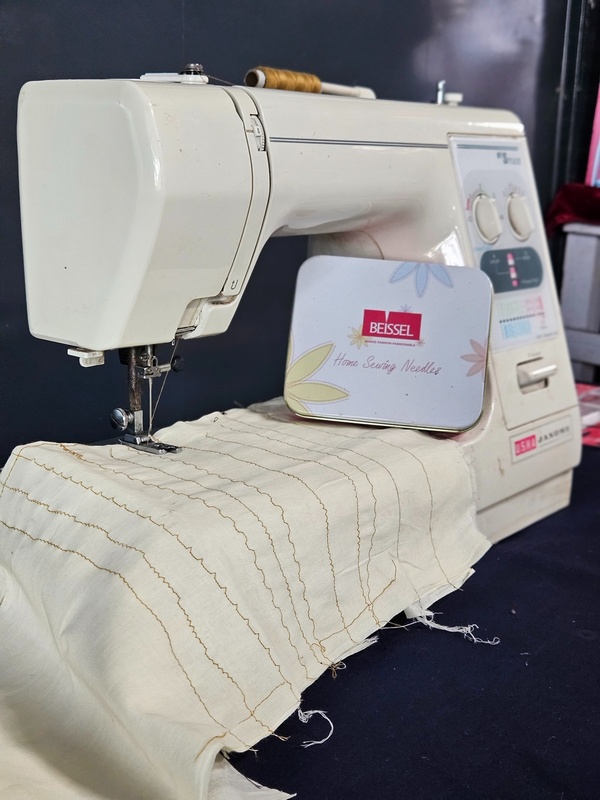
Twin Jeans sewing machine needles are used in domestic sewing machines for sewing denim, canvas, and other heavy woven fabrics while producing two parallel rows of stitches simultaneously. Constructed with two jeans needles mounted on a single shaft, this system provides strong penetration through thick materials and multiple fabric layers, making it ideal for jeans hems, top stitching, and decorative seams on heavy fabrics.
₹57.14
₹57.14
₹57.14
Log in for dealer pricing
Non-returnable
Out of stock Out of stock
size
Select size
point
Select point
Customize
10
[tag] Needle || [text] Twin needles has two needles on a single shank. The designation of needle, for example, 2.5/80 means that the distance between the two needles is 2.5 mm and the size of needles are 80. The two needles are spaced ranging from 1.6 mm to 6 mm. || [tag] Needle || [text] Sizes of the needles range from 70 to 100. Bigger needles tend to have greater distances between them. The Twin needle will have to be threaded manually. Automatic threading will not work. || [tag] Needle || [text] The needles themselves may be Universal, Stretch, Ball point, Embroidery and others. || [tag] Stitch type || [text] In stretch fabrics, Twin needles can be used in place of Serger. The appearance of stitch is usually parallel on top and zigzag at the bottom. Zigzag stitch allows the thread to stretch so than they do not break in wear. || [tag] Cloth || [text] In woven fabrics, twins are decorative. They can be used for pintucks, hems and decorative topstitching. || [tag] Thread || [text] Twin needle can be used in any sewing machine which can sew both Straight stitch and zigzag. Bobbin does zigzag stitch. If the sewing machine does not have zigzag stitch capability, twin needles cannot be used. || [tag] Thread || [text] The maximum size of needle in terms of distance is determined by the Presser foot. If too wide a needle used, it will hit sides of Presser feet and break. It is a good idea to first to test stitching on a scrap cloth to ensure that the needles do not hit the sides of the Presser foot. This is definitely recommended especially if you are use ing a decorative stitch. || [tag] Stabilizer || [text] Use the extra thread holder hook that comes with your machine for the second spool. || [tag] Presser Foot || [text] Ensure that the two threads do not cross their path while travelling from thread holder to the needle. || [tag] Sewing style || [text] Sew slowly. Use stabilizer/backing for thin fabrics. While hemming, this will help to avoid tunneling effect between the two rows of stitch on top. ||
1
Twin Jeans
10
[tag] Needle || [text] Twin needles has two needles on a single shank. The designation of needle, for example, 2.5/80 means that the distance between the two needles is 2.5 mm and the size of needles are 80. The two needles are spaced ranging from 1.6 mm to 6 mm. || [tag] Needle || [text] Sizes of the needles range from 70 to 100. Bigger needles tend to have greater distances between them. The Twin needle will have to be threaded manually. Automatic threading will not work. || [tag] Needle || [text] The needles themselves may be Universal, Stretch, Ball point, Embroidery and others. || [tag] Stitch type || [text] In stretch fabrics, Twin needles can be used in place of Serger. The appearance of stitch is usually parallel on top and zigzag at the bottom. Zigzag stitch allows the thread to stretch so than they do not break in wear. || [tag] Cloth || [text] In woven fabrics, twins are decorative. They can be used for pintucks, hems and decorative topstitching. || [tag] Thread || [text] Twin needle can be used in any sewing machine which can sew both Straight stitch and zigzag. Bobbin does zigzag stitch. If the sewing machine does not have zigzag stitch capability, twin needles cannot be used. || [tag] Thread || [text] The maximum size of needle in terms of distance is determined by the Presser foot. If too wide a needle used, it will hit sides of Presser feet and break. It is a good idea to first to test stitching on a scrap cloth to ensure that the needles do not hit the sides of the Presser foot. This is definitely recommended especially if you are use ing a decorative stitch. || [tag] Stabilizer || [text] Use the extra thread holder hook that comes with your machine for the second spool. || [tag] Presser Foot || [text] Ensure that the two threads do not cross their path while travelling from thread holder to the needle. || [tag] Sewing style || [text] Sew slowly. Use stabilizer/backing for thin fabrics. While hemming, this will help to avoid tunneling effect between the two rows of stitch on top. ||